Hyundai i30 2025 Petrol
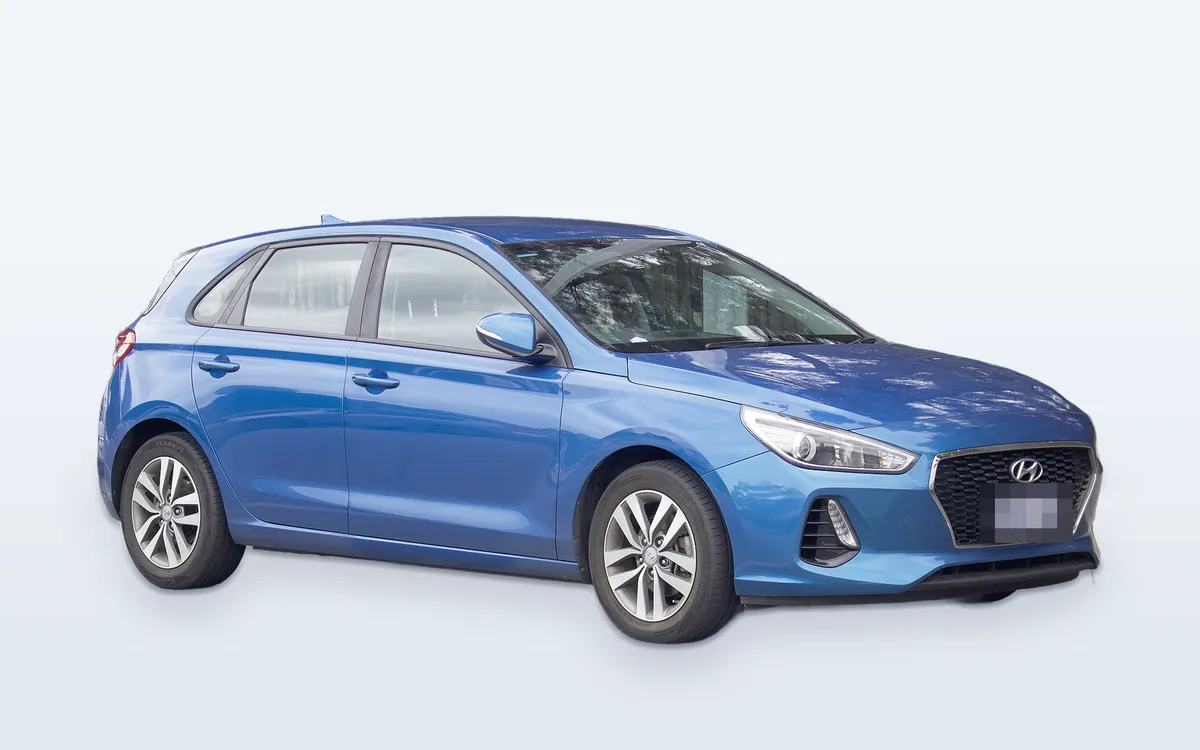
Photo EurovisionNim CC BY-SA 4.0 cut out, colour graded, new background
No score yet: every car of this build year has had its first APK in 2030
About as many APK faults as the average car of its age estimate
RDW G4LK
Value and price
What it costs to own
Your own use per 100 km
Counted for the coming year, 15,000 km a year, every province.
The coming year
In 5 years: value loss €10,550, worth €19,890 then.
Not counted: insurance, upkeep and repairs, interest and parking. Value loss: the price you pay minus what cars like it ask at the end, by our price model of 163,374 adverts, at your odometer and kilometres a year. Selling to a dealer brings less than an asking price. Use: 6.4 litres per 100 km as registered (WLTP), counted as 7.4 litres per 100 km: cars use about 15% more on the road than registered (TNO, 2025). Fuel at €2.10 a litre, the average pump price of 23 Nov 2026 (CBS). Fuel and electricity are counted at today's prices in every year. Road tax: the tax office's tariff of 2026 for every 3 months from today; later tariffs are not set yet. An electric car pays 70% of the tariff up to 2028, 75% in 2029 and all of it from 2030.
Road tax
Belastingdienst
Per province
| Province | A month | Per 3 months |
|---|---|---|
| Drenthe | €60 | €179 |
| Flevoland | €58 | €174 |
| Friesland | €60 | €179 |
| Gelderland | €61 | €184 |
| Groningen | €61 | €182 |
| Limburg | €59 | €177 |
| Noord-Brabant | €59 | €176 |
| Noord-Holland | €57 | €172 |
| Overijssel | €57 | €172 |
| Utrecht | €58 | €175 |
| Zeeland | €58 | €174 |
| Zuid-Holland | €63 | €188 |
Each version of this model, build year and fuel in the RDW register, at the average empty weight of its cars plus 100 kg: the tariff counts the mass ready to drive. One car can fall a weight class higher or lower. The tax office's tariff for 2026, the province's surcharge included (read on 15 Nov 2026, checked against its own calculator). Charged per 3 months; by direct debit a third of that each month. The tax office's calculator
What these 15 cars are
Other versions, 1 car: 160 hp (1 car).
140 hp (12 cars): RDW registers this version as a hybrid without a plug (usually a mild hybrid). Sellers advertise it as petrol.
160 hp (1 car): RDW registers this version as a hybrid without a plug (usually a mild hybrid). Sellers advertise it as petrol.
Trim levels the adverts name
Options
adverts
On most of these cars
- Climate control
- Air conditioning
- Parking sensors
- Reversing camera
- Keyless entry
- Cruise control
- Lane assist
- Collision warning
Show all 27
- Front parking sensors
- LED headlights
- Adaptive headlights
- High beam assist
- Navigation
- Apple CarPlay
- DAB radio
- Voice control
- Alloy wheels
- Tinted windows
- Heated seats
- Blind spot warning
- Digital instrument display
- Android Auto
- Heated steering wheel
- Electric seats
- Seat memory
- Roof rails
- Adaptive cruise control
On some of these cars
APK record by build year
Model faults per 100 cars by build year
| Build year | This model | Average for its age | Registered cars |
|---|---|---|---|
| 2011 | 102.8 | 106.4 | 11,223 |
| 2012 | 108.2 | 90.7 | 9,890 |
| 2013 | 102.9 | 72.5 | 5,134 |
| 2014 | 79.8 | 62.7 | 1,273 |
| 2015 | 44.7 | 51.7 | 1,043 |
| 2016 | 34.7 | 40.0 | 711 |
| 2017 | 19.9 | 26.4 | 974 |
| 2018 | 10.2 | 17.4 | 1,278 |
| 2019 | 6.8 | 8.8 | 1,052 |
| 2020 | 4.2 | 8.1 | 432 |
| 2021 | 5.6 | 4.0 | 145 |
Defects per 100 cars by build year
| Build year | This model | Average for its age | Registered cars |
|---|---|---|---|
| 2011 | 381.6 | 349.3 | 11,223 |
| 2012 | 385.2 | 310.1 | 9,890 |
| 2013 | 383.0 | 271.2 | 5,134 |
| 2014 | 319.7 | 245.1 | 1,273 |
| 2015 | 243.7 | 218.3 | 1,043 |
| 2016 | 211.1 | 179.7 | 711 |
| 2017 | 119.1 | 135.8 | 974 |
| 2018 | 92.4 | 101.4 | 1,278 |
| 2019 | 61.4 | 69.8 | 1,052 |
| 2020 | 48.6 | 65.8 | 432 |
| 2021 | 30.3 | 38.0 | 145 |
Other build years for sale
Show all 18 build years
2021 40% more faults €16,950 score 47 2020 49% fewer faults €15,450 score 59 2019 23% fewer faults €14,700 score 45 2018 42% fewer faults €12,745 score 50 2017 25% fewer faults €12,325 score 33 2016 13% fewer faults €10,750 score 27 2015 14% fewer faults €9,198 score 26 2014 27% more faults €9,398 score 14 2013 42% more faults €6,725 score 15 2012 19% more faults €4,423 score 28 2011 average €2,600 score 42 2010 average €3,223 score – 2009 average €3,450 score – 2008 average €2,173 score – Similar cars



 Hyundai i30 2025this car median €29,945 –
Same engine in other models
In the 103 kW (140 hp) version of this model
APK defects: the cars with the G4LK against the cars of the same models and build years with another engine, as inspectors recorded them.
Other models with the G4LK
 Kia Ceed built 2021 to 20251,011 registered with it Price and score: the 2022 hybrid median €19,900 –
 Kia Xceed built 2021 to 2025287 registered with it Price and score: the 2022 hybrid median €20,200 –
 Kia ProCeed built 2021 to 2023152 registered with it Price and score: the 2021 hybrid median €19,447 –
Spec sheet
RDW
- Engine power (average)
- 21 kW (29 hp)
- Empty weight (average)
- 1,290 kg
- CO₂ (average)
- 121 g/km
- Length and width
- 4.59 m long, 1.80 m wide, without mirrors
The maker's figures, as the adverts state them adverts
- Torque
- 253 Nm
- 0 to 100 km/h
- 9.9 s
- Top speed
- 197 km/h
- Boot
- 602 l, 1,650 l with the back seats folded
What the adverts say
adverts
Adverts seen up to 23 Nov 2026.